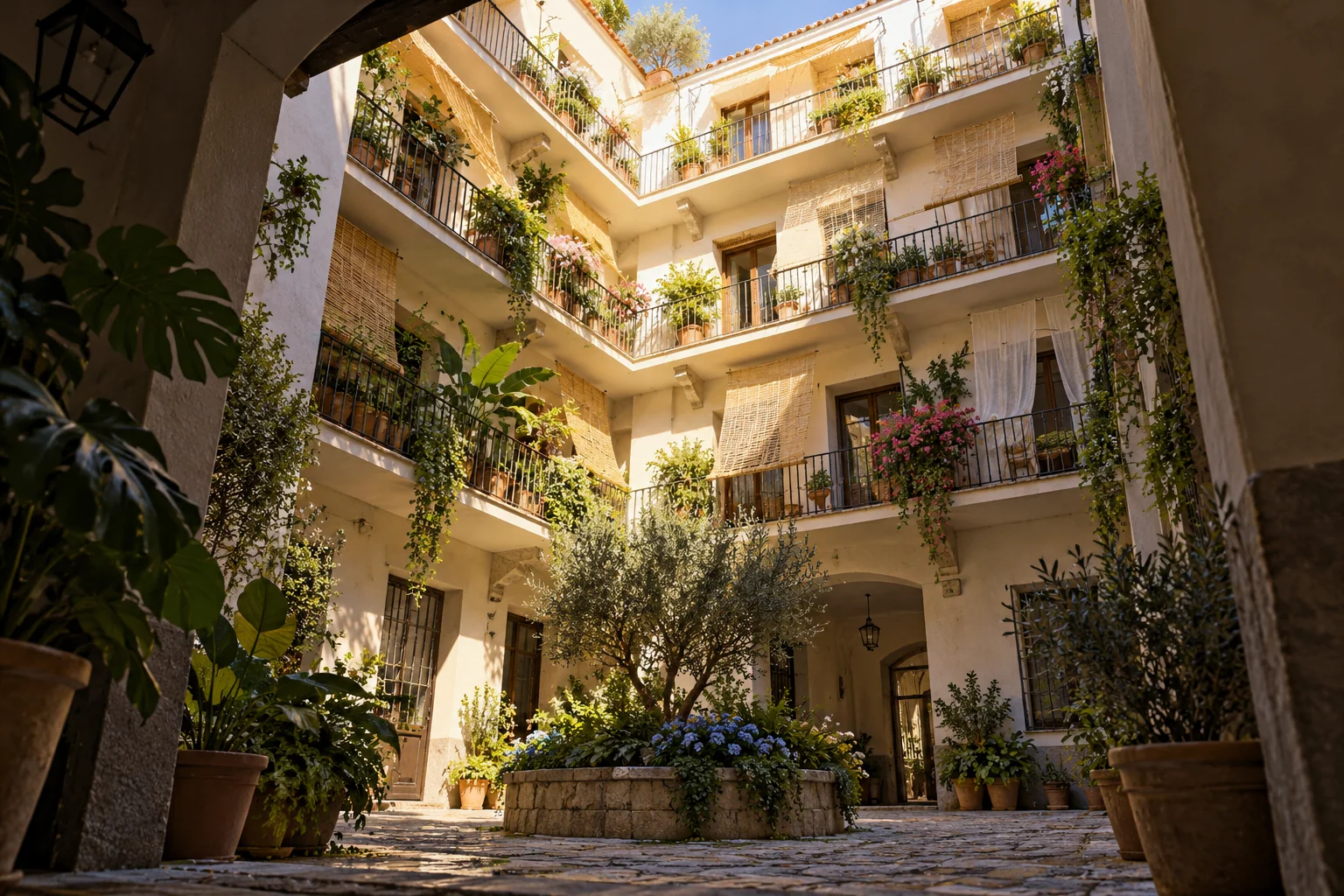
Every Costa del Sol apartment comes with a building behind it. How to read the fees, minutes, derramas, reserve and rules — and which documents to ask for, and when, before you commit.
The terrace catches the last of the afternoon, the pool below has emptied, and somewhere a gardener is coiling a hose for the night. It is an easy moment to fall for a Costa del Sol apartment, and it is worth pausing on, because almost everything in that view belongs to someone else as well. The pool, the gardens, the lift that carried you up and the gate that closed behind you are shared, and they are paid for, decided on and argued over by a community of owners you are about to join.
A monthly community fee tells you what that community charges today. It does not tell you what was approved, postponed or quietly worried over at last spring's meeting. This guide follows the papers that do, read against Spain's Horizontal Property Act, Ley 49/1960 — the principal law governing communities of owners. Have an independent lawyer assess how it applies to your purchase; at Beyond Blue we would rather you arrive at a viewing with these questions than discover the answers after completion.
Who actually charges the home
Picture the drive into a gated development in Nueva Andalucía: a barrier, a lawn kept greener than the hills above it, a second pool glimpsed behind the first block. In some developments, a building community and a wider urbanisation may each send their own bill.
So begin by asking which bodies charge the property, and how often. Request the ordinary fee for the apartment itself and any separate contributions for a garage space, storage room or the wider estate. List every shared facility you passed on the way in and ask who owns, runs and pays for each one.
Ask your lawyer to explain exclusive-use areas against shared elements, particularly if a garden, roof terrace or parking space is part of why you want the home. The fact that the current owner uses a space does not settle its legal status.
What the ordinary fee buys
The pool cleaning, the gardening, regular lift maintenance by the maintenance company, the porter who knows which deliveries are yours: all of it sits in the approved annual budget. Ask for that budget, along with the current charge to the exact property. Where a heading is broad, such as maintenance or general services, ask what it covers, and establish which costs you will still pay directly.
Then hold the services up against the life you intend to live there. If you will visit for a few weeks each season, a community that handles more on your behalf may be worth a higher figure. If you plan to stay year-round, look at access, facilities and upkeep in the months you will actually be present.
Do not choose a home simply because its fee is lower than the next. In Puerto Banús, two flats a short walk apart can sit in buildings with very different histories. The number only means something once you know what lies behind it, and that is written in the minutes.
Reading the minutes
Ask for recent ordinary and extraordinary meeting minutes, with enough years to follow any major work under discussion. A subject that returns meeting after meeting usually deserves a fuller explanation than the single line in the latest summary.
Separate four stages: a concern raised, a report commissioned, work approved and payment scheduled. Then ask the administrator which stage each item has really reached. A conversation about replacing the lifts is a very different thing from a signed contract with instalments already falling due.
Keep the focus on what affects you. Would proposed works limit access during the weeks you plan to stay? Is there an unresolved technical report your own surveyor should see? Where the minutes mention works that do not yet have agreed funding, ask how and when the community expects to pay for them, and request the supporting papers through the seller or an authorised channel.
Derramas: the levy beyond the budget
A derrama is an extraordinary contribution on top of the ordinary budget, raised for a roof, a façade, a new pool plant or similar. Ask whether one has been approved, what it funds, the share attributable to the apartment and the dates it falls due. Ask, too, whether further projects are being priced but have not yet reached a vote.
Article 17.11 of Ley 49/1960 places improvement levies on whoever owns the property when the relevant amount becomes due. Have your lawyer classify the particular work and check how the contract allocates it; do not assume every levy follows the same rule.
If known payments run beyond completion, ask for a written schedule. If the seller agrees to cover a cost, have the mechanism set down in the contract rather than resting on a handshake.
The debt certificate, and when to ask for what
Article 9 of Ley 49/1960 provides for a certificate confirming the seller's position on community contributions, required at transfer unless the buyer expressly waives it. The same article makes the property itself answerable for unpaid general expenses for the elapsed part of the year of purchase and the previous three calendar years. Certain arrears can follow the apartment, not the person who ran them up.
Timing matters, because the papers do different jobs at different stages:
- Early, while you are shortlisting: the ordinary fee, the approved budget, recent minutes and whatever the seller or administrator can share on arrears and approved levies.
- Before you sign anything binding: a clear account of unresolved costs — pending works, disputed balances, levies still to fall due — and how the contract will handle each liability.
- Close to completion: an up-to-date formal debt certificate, obtained and reviewed by your lawyer. A screenshot of a recent bank transfer is not a substitute.
Keep the seller's individual account separate from the health of the whole building. Ask how much is owed across the community and for how long; a clean account for your apartment says nothing about whether the community has collected enough to meet its commitments.
Reserves and the maintenance plan
Every building ages in the sun and salt air, and the reserve fund is one way a community pays for that ageing. Article 9.1(f) of Ley 49/1960 requires the reserve to hold no less than 10% of the community's last ordinary budget — a useful benchmark, though a reserve at that level will not necessarily cover a major project.
Request the reserve position and set it beside the projects in the minutes. Ask whether quoted balances include money already committed to work, whether large invoices are still unpaid and whether any funding is expected rather than received. If the building has commissioned technical reports, have the relevant findings reviewed by your own professional.
The most revealing exercise is to ask the administrator to walk you through one major project, from decision to funding to payment dates. The explanation usually shows which document you still need.
Rules that shape your days
Guests at the pool, a dog on the morning walk, deliveries at the gate, furniture on the terrace, the renovation you have been sketching since the first viewing: request the statutes and any internal rules, and test each against them. "The community is very relaxed" is not an answer.
If you hope to let the apartment to holidaymakers, article 7.3 of Ley 49/1960 requires the owner to obtain the community's prior express approval. Under article 17.12, an agreement approving, limiting, conditioning or prohibiting tourist letting needs the vote of three-fifths of all owners who also represent three-fifths of the participation shares. Additional Provision Two allows owners who were already carrying on the activity before the reform took effect on 3 April 2025, having previously come under the tourism regulations, to continue on the conditions and timescales those regulations set — in effect, a transitional rule. A seller's rental history or registration does not prove that your plan is authorised, so ask your lawyer about both the community position and the separate tourism requirements.
A second visit for the building
On the next viewing, give the shared spaces their own time. Walk from the parking space to the front door, note where visitors arrive, and try the lift and stairs with shopping, golf bags or a pushchair in mind. If San Pedro de Alcántara or Estepona is on your shortlist, test the route between the building and your daily destinations, and return at a different hour if you can. What you observe is a starting point for questions; documents and professional inspection settle the rest.
Your document checklist
- Ordinary community fee for the apartment, plus any garage, storage or urbanisation charges
- Approved annual budget
- Recent ordinary and extraordinary minutes
- Details of approved or pending derramas, with amounts and due dates
- Reserve fund position and any committed funds or unpaid invoices
- Statutes and internal rules, including any agreement on tourist letting
- Relevant technical reports
- An up-to-date formal debt certificate, close to completion
Ask for the first items while shortlisting, settle unresolved costs and their contractual treatment before anything binding, and leave the formal certificate to your lawyer near completion. Leave uncertain costs visible in your plan rather than counting them as zero.
Community costs sit alongside the purchase costs. Andalucía's transfer tax (ITP) on a resale purchase is 7%. Reduced rates apply only to certain qualifying main-home purchases; our guide to what buyers really pay in taxes and fees sets out the rest. Our resale purchase checklist connects these findings to the wider transaction, and if you are buying from abroad, our complete guide to buying in Marbella as a foreigner covers the steps around them.
Tell us the area and the kind of apartment you are looking for — Nueva Andalucía, Estepona or elsewhere on the coast — and Beyond Blue will put together a shortlist and help you request the early community papers for each home before you view.
FAQ
What is a derrama on a Costa del Sol apartment? A derrama is an extraordinary contribution raised by the community of owners on top of the ordinary budget, usually for specific works. Under article 17.11 of Ley 49/1960, improvement levies fall on whoever owns the property when the amount becomes due, so ask whether any are approved or pending before you buy and have your lawyer check how the contract allocates them.
Can I inherit the seller's unpaid community fees? Potentially, yes. Article 9 of Ley 49/1960 makes the property answerable for unpaid general expenses for the elapsed part of the year of purchase and the previous three calendar years, and provides for the community debt certificate at transfer unless the buyer expressly waives it. Ask about arrears early, agree how any liabilities will be handled before you sign anything binding, and have your lawyer obtain an up-to-date certificate close to completion.
How large should the community reserve fund be? Article 9.1(f) of Ley 49/1960 sets a minimum of 10% of the community's last ordinary budget. Treat that as a floor, and compare the actual balance — less any committed funds — with the works in the minutes.
Can I let my apartment to holidaymakers? Not automatically. Article 7.3 of Ley 49/1960 requires the community's prior express approval, and under article 17.12 an agreement on tourist letting needs three-fifths of all owners representing three-fifths of the participation shares. Additional Provision Two protects certain owners already operating under the tourism regulations before 3 April 2025, and separate tourism requirements also apply. Check both with your lawyer.